
The Source Field: A Return to Aether
Why Empty Space Might Not Actually Be Empty, and What a Return to Aether Might Solve

Most of us learn to notice the solid things in our world and overlook the space between them. We see the stars and assume the darkness around them is an empty void. We watch people moving through a room and miss the atmosphere that carries mood, tension, and warmth through apparently “empty” air. We talk about matter and energy as if they sit on isolated islands floating in nothing.
Netism presents a different view: visibly empty space is not truly empty; it is everything waiting in potential.
In Netist cosmology, aether, what we refer to as the Source Field, is a continuous, living medium that underlies all phenomena. Matter, light, gravity, and even consciousness show up as patterned motions in this field. A ball flying through the air is not mass moving through a fluid-like medium; the ball is aether that is phase-locked into a solid form flying through the same aether in a less structured state that we call “empty space.” Everything is the Source Field expressing itself at different densities, frequencies, and degrees of coherence; one medium, many patterns.
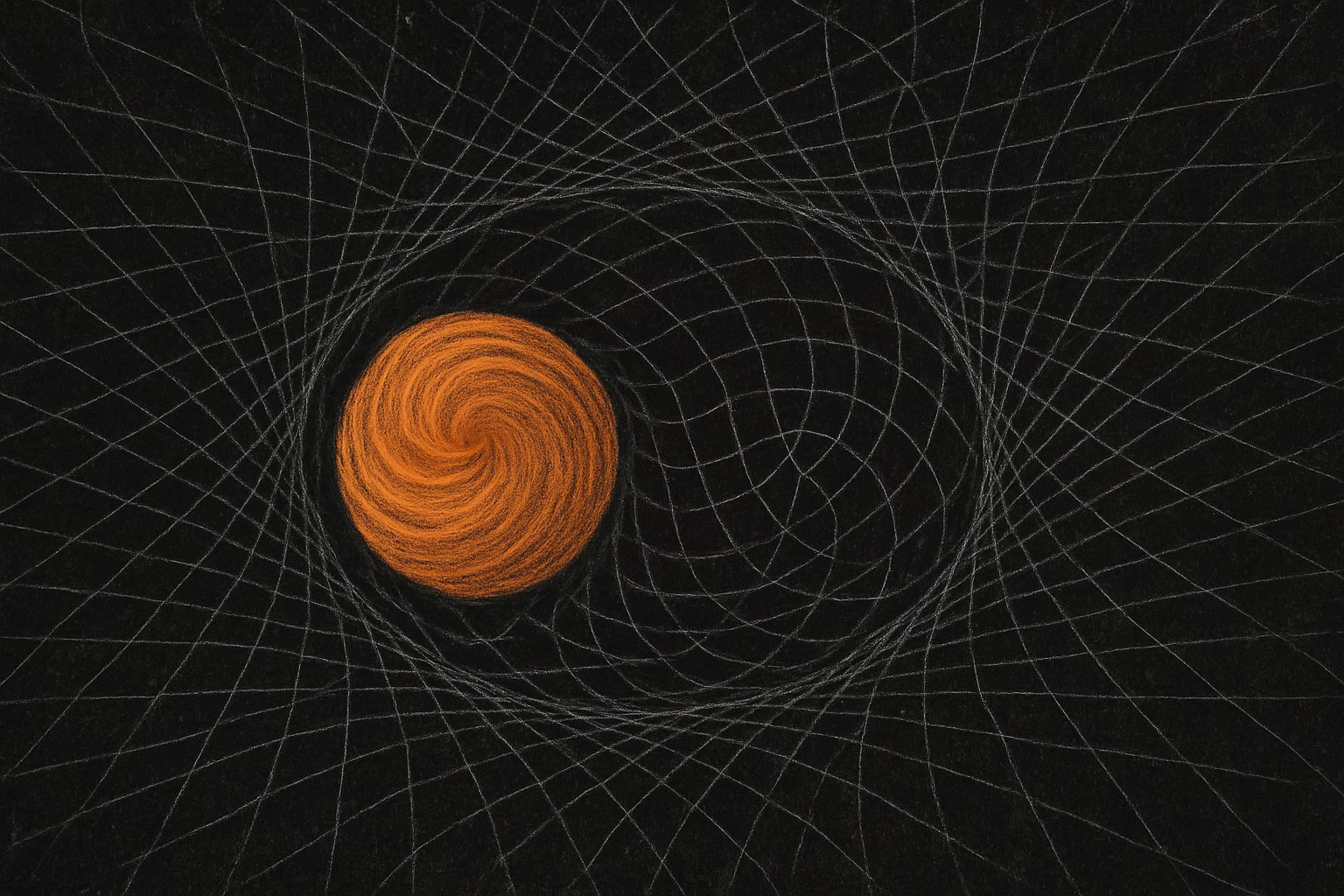
From Vacuum to Source Field
Modern physics often describes space as a vacuum: almost empty, but with subtle “quantum fluctuations” and abstract fields defined by equations. In practice, space is treated as a high-tech nothingness where the real actors—particles and forces—do their work.
From a Netist perspective, treating space as truly empty creates more questions than it answers:
How does light keep a steady wave pattern across millions of miles if nothing is there to carry the wave?
How does wireless power or radio work between two coils if there is no shared “something” to hold the near field and pass along phase and resonance?
Why does the Earth–ionosphere act like a giant resonant cavity and support standing waves if the region between transmitter and receiver has no role?
How do entangled particles stay coordinated with perfect timing across distance if there is no continuous link?
Why do galaxies rotate and bend light as if an unseen structure surrounds them?
What sets the “constants of the vacuum” if the vacuum has no structure at all?
Why do empty gaps in devices produce real forces, as with the Casimir effect?
Why do shapes, cavities, and metamaterials so strongly steer energy if the space between them is passive?
Mainstream answers exist—curved spacetime, quantum nonlocality, dark matter, dark energy—but they tend to pile abstraction on top of abstraction. The equations work because they rely on “virtual particles,” named because they have never been experimentally observed but serve to balance formulas as fluctuations in an assumed empty space.
Netism’s model has the following key components:
The Source Field is a real, universal medium.
It’s not a gas or a mechanical fluid, but a continuous field that fills all of space. In its resting state, it is neutral and silent. Netism calls this Zeru, pure undifferentiated potential.Every “thing” is a pattern in this field.
Light is a ripple, gravity is a pressure gradient, and atoms are standing wave phase-locked into stable form. Entanglement is coherence in one continuous medium, not spooky action across an empty void.Space is not the stage. Space is the actor.
The Source Field isn’t a substance materials flow through, it is the substance of everything, rearranging itself at different frequencies into the forms we see.
This understanding mirrors aether interpretations from early electrical pioneers such as Nikola Tesla and C. P. Steinmetz and remains consistent with Maxwell’s equations of electromagnetism, which treat space as a structured medium. As field science advances, more researchers and independent experimenters are beginning to ask the question: should aether return to the conversation?
Aether Without the Baggage
The word aether carries historical baggage, including the famous Michelson–Morley experiment that seemed to bury it in 1887. However, this experiment was based on one critical assumption that does not hold to all aether models: it treats aether as a resistant substance that produces drag when aggrivated. Netism’s model and many others treat aether as resonant and reactive. It does not produce drag because it is responsive to movement.
Netism’s Source Field updates aether with three key differences:
Non‑material
The Source Field is not made of particles or fluid. It’s closer to what modern physics calls a field: something continuous whose state can vary from point to point.Coherence‑first
What matters most is pattern, not just magnitude. The way waves interlock, resonate, and interfere is as important as their strength.No “ether wind”
There is no universal rest frame, no resistance, and no cosmic air current you can drift through or measure.
Netism agrees with modern physics on some key points:
Space has real properties.
Fields fill space even in their lowest-energy state.
There is no preferred “stationary ether frame” to move through.
Where Netism goes further is in unification and interpretation. It claims that all fields and forces—electromagnetic, gravitational, nuclear—are distinct behaviors of one underlying medium, the Source Field.
Why “Empty Space” Breaks Down
Let’s look at a few everyday mysteries through the Source Field lens.
1. Light Without a Medium
In the standard picture, light is both:
a wave (it diffracts, interferes, polarizes), and
a particle (discrete photons deliver energy in packets).
Yet somehow these waves travel through a vacuum, and the only “thing” that ripples is the electromagnetic field itself.
Netism’s model proposes:
Light is a wave in the Source Field.
The field compresses and relaxes rhythmically, just as water forms waves when you disturb it.A photon is a quantized pulse, a localized crest in that wave pattern, not a tiny bullet flying through emptiness.
Light’s constant speed is a property of the medium determined by how fast the Source Field responds to a disturbance, just as the speed of sound depends on the air.
2. Gravity Acting at a Distance
Newton gave us gravity as an instant pull between masses. Einstein replaced that with curved spacetime: mass tells space how to curve, and curved space tells matter how to move.
Netism asks: what is this thing that’s curving? If it has no physical substance, we’re back to bending a sophisticated “nothing.”
In the Source Field view:
Mass is a localized shaping of the field with tighter structure and internal tension.
Gravity is the Source Field flowing toward balance, like water moving into a hollow or air rushing toward low pressure.
Objects follow those flows. The inverse-square law emerges from how the field relaxes around concentrated tension.
3. Quantum Entanglement
Entangled particles behave as one system, even when separated by large distances. Measure one; the other “knows” instantly. Experiments suggest no signal is traveling between them at or below light speed.
In the empty-space view, this is “nonlocal correlation” with no physical bridge. With the Source Field, it’s straightforward:
Entangled particles are two expressions of one pattern in the field.
They were never truly separate; they’re like two knots in the same rope. Change the tension at one knot and the pattern of the rope changes, affecting the other knot immediately.
The two particles began as one; they react instantaneously because they are still the same particle, split across space and connected through the Source Field.
4. Dark Matter and Dark Energy
Galaxies rotate as if they contain far more mass than we can see. The universe expands as if some invisible pressure is pushing everything apart. To patch this, mainstream models introduce dark matter and dark energy: invisible mass and invisible pressure making up most of the cosmos.
In the Source Field model:
A galaxy is a coherent vortex in the field whose structure extends far beyond visible stars.
The accelerated expansion is the Source Field’s internal tension expressing outward—a kind of cosmic exhalation that becomes dominant as matter thins out.
Instead of adding new entities, Netism points to an old missing character: the medium itself.
The Long Memory of Aether
Netism isn’t inventing a field‑filled cosmos from scratch. It’s reconnecting to a lineage of ideas and giving them a clear, unified language.
Ancient Egypt spoke of Nun: the primeval waters, a limitless plenum of unformed potential.
Vedic texts named Akasha, the subtle space that carries vibration before form.
Aristotle described a fifth element, aether, forming the incorruptible heaven.
Faraday drew real “lines of force” in space and showed that energy lives in fields, not just in matter.
Maxwell encoded aether into equations where stresses and energy propagate through space as waves.
Tesla treated Earth and sky as components of a single resonant circuit, sending energy through the environment instead of just through wires.
Steinmetz spoke of electricity as a product of magnetic and dielectric fields in the space around conductors.
Modern physics refined the math and discarded the language of aether, but the underlying intuition never fully died. Netism picks it up, pushes it further, and says:
The “vacuum” is a misnamed non-material ocean. We call it the Source Field.
Geometry: The Field’s Native Language
If the Source Field is the medium, geometry is its grammar.
When you vibrate a plate covered in sand with a harmonious tone, you get smooth, circular patterns. Change the tone, and the pattern shifts. The field behaves similarly: when energy moves through it in harmonic ways, it organizes into form.
Netism highlights a few critical geometries:
The Torus: Continuous Circulation
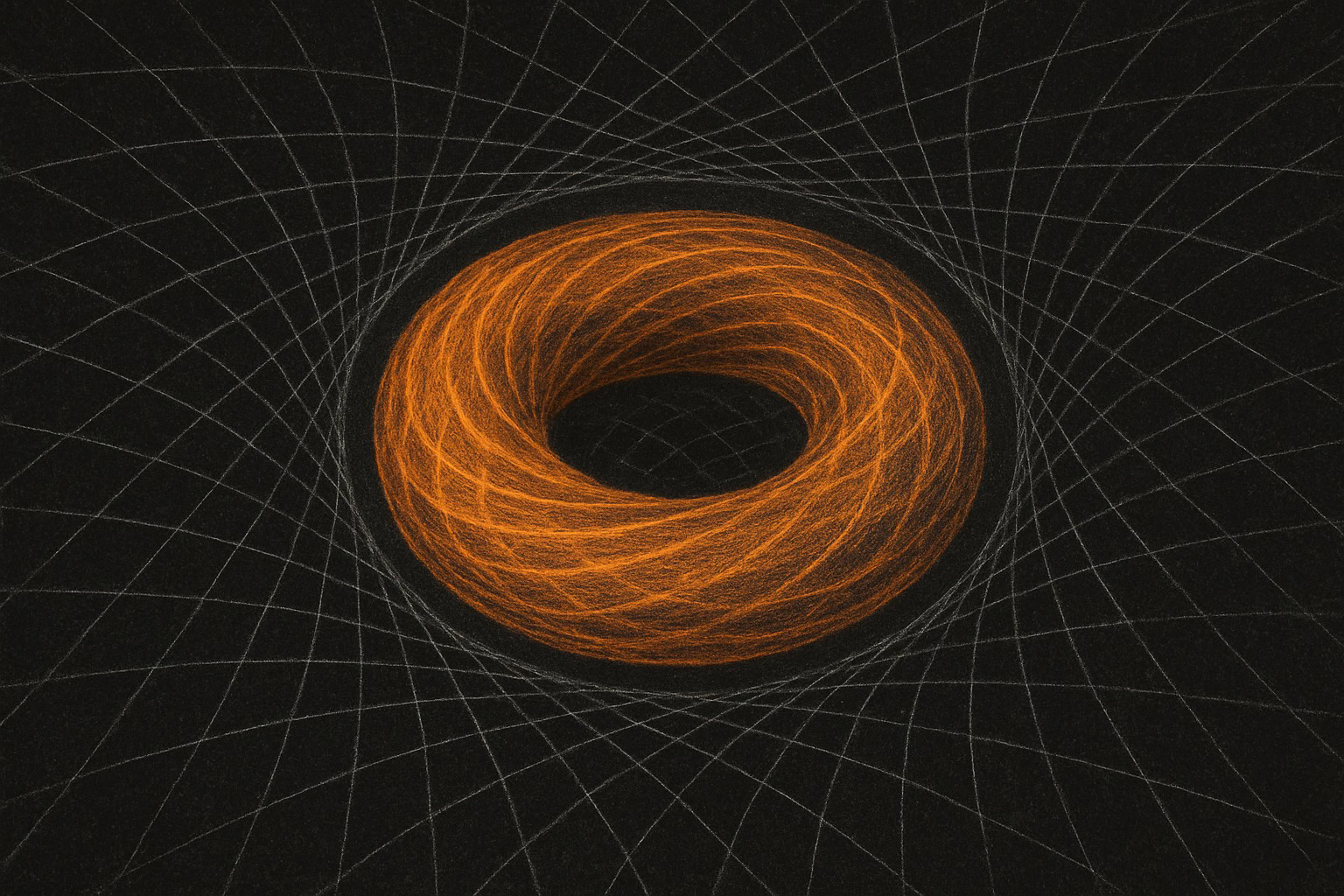
Imagine a doughnut-shaped flow: energy enters through one pole, dives through the center, exits the other pole, then curves around the outside and returns again. That’s a torus.
You see toroidal behavior in:
magnetic fields around a bar magnet or planet,
the heart’s electromagnetic field,
vortex structures in plasmas and fluids,
many models of atomic and subatomic fields.
The torus is how the Source Field shows continuous circulation. It breathes in an endless cycle of centripetal and centrifugal flow.
The Hyperboloid: The Throat of Transformation
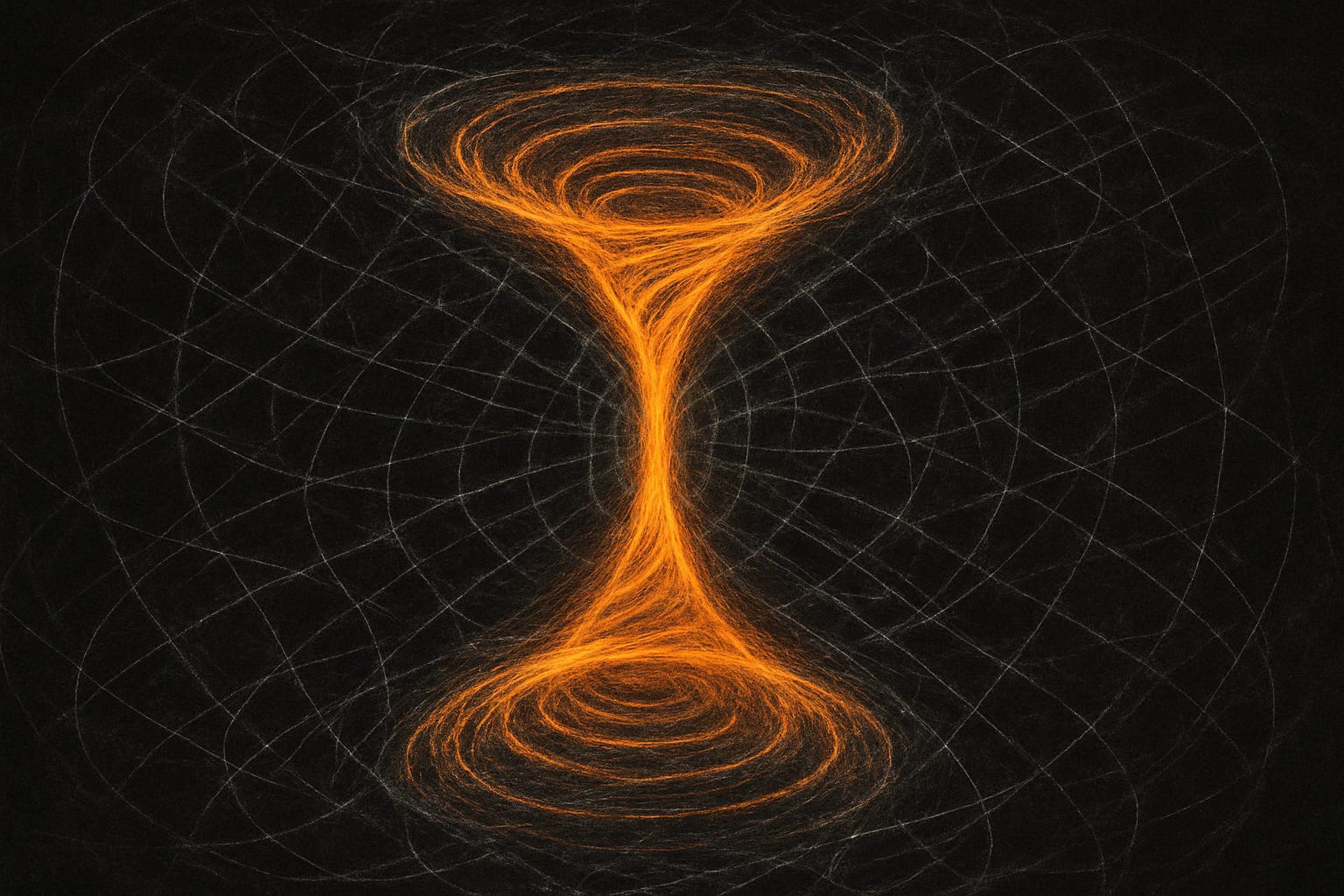
Inside every torus is an hourglass‑shaped hyperboloid. This “throat” is where inward and outward flows meet, twist, and exchange.
It’s the natural geometry of focused transformation:
In field terms: where energy converges, re‑phases, and reverses direction.
In consciousness terms: the turning point where inner intention becomes outer effect.
Without a hyperboloid, a torus would be a static loop. With it, the loop becomes a living circuit.
The Sphere: The Womb of Balance
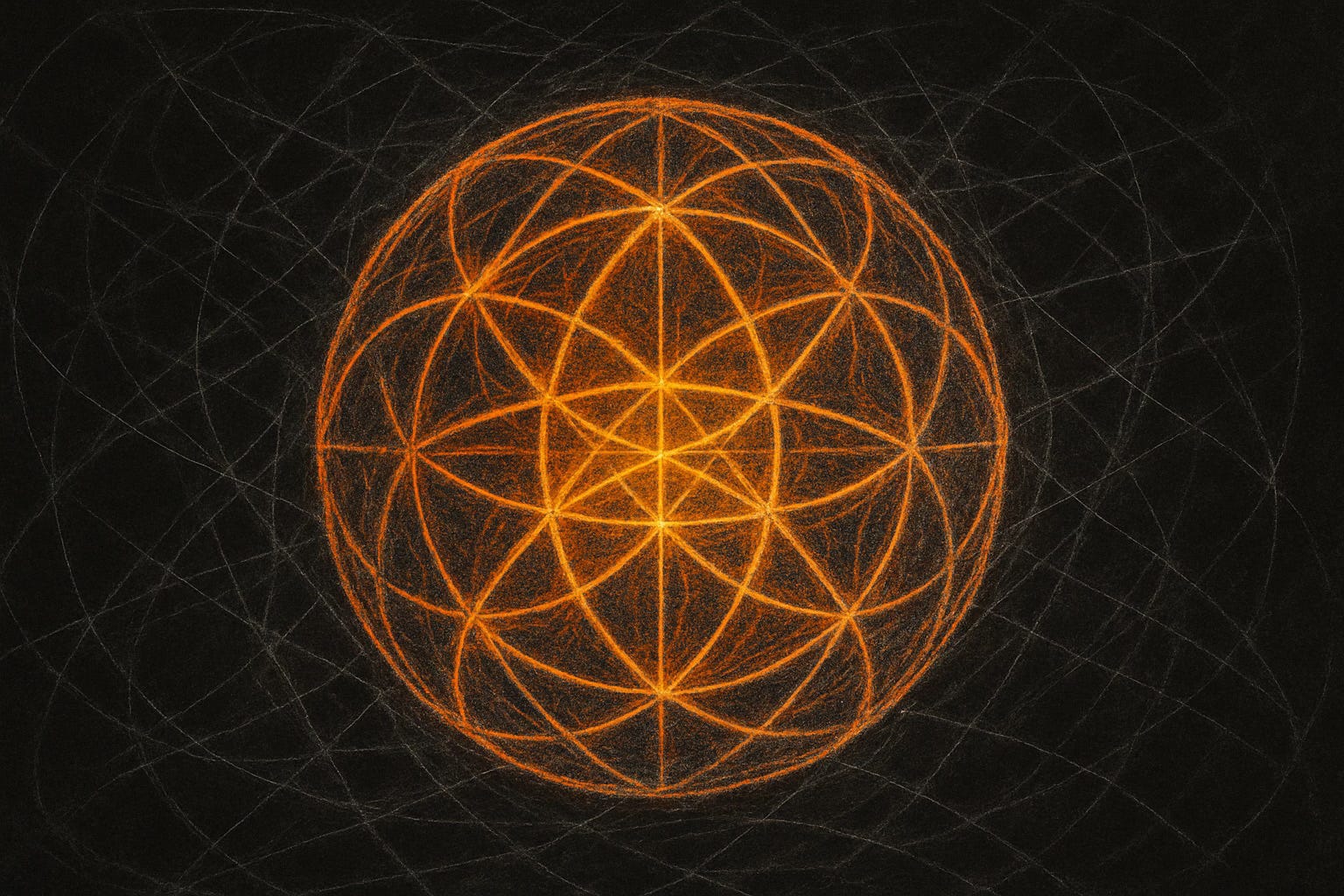
The sphere is the simplest expression of balance: every point on its surface equidistant from the center. That symmetry is why:
planets form spheres,
droplets form spheres,
many field distributions tend toward spherical symmetry.
A sphere forms from the composite of a torus with a hyperboloid-shaped void inside.
Phi and Living Growth
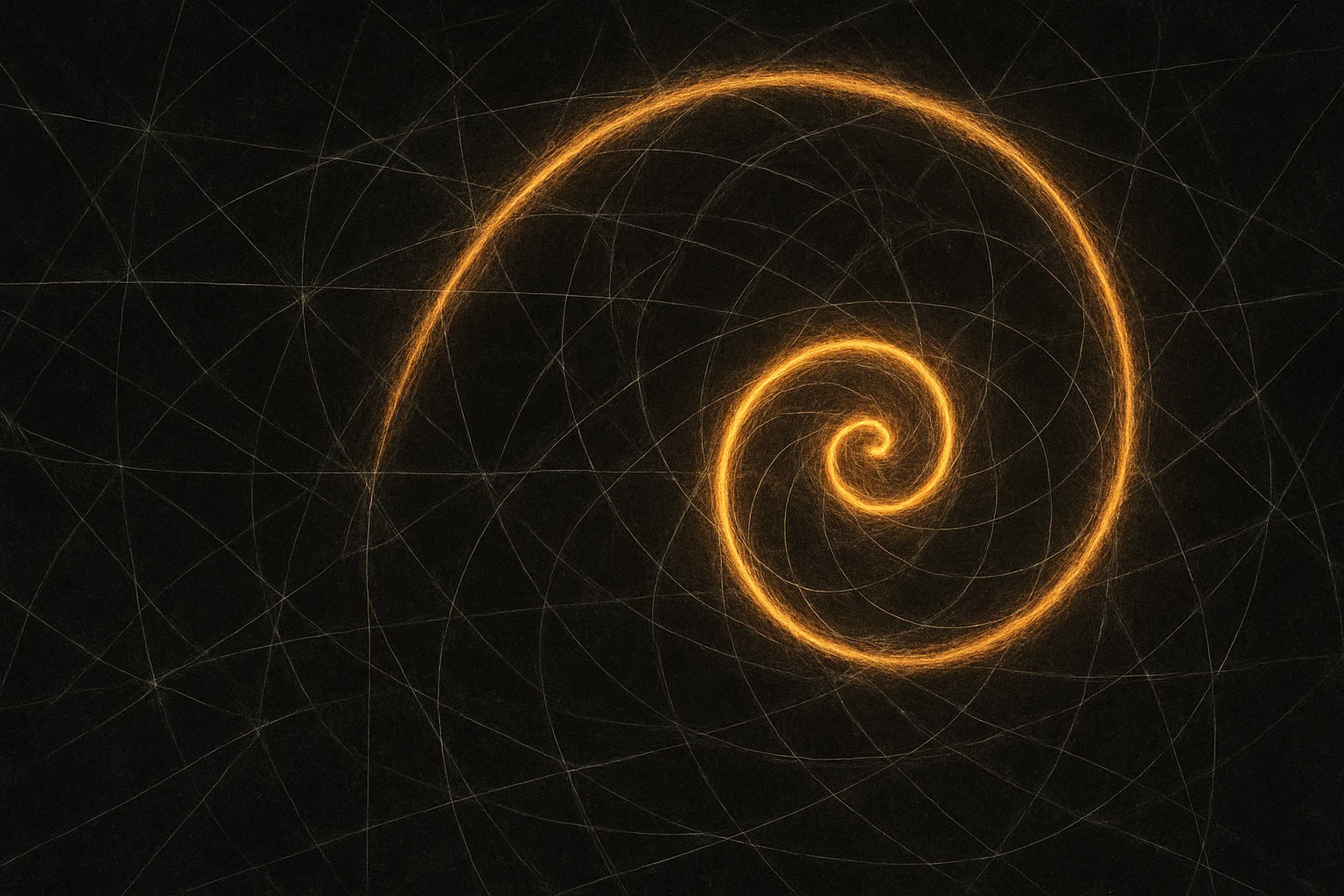
The golden ratio, phi ≈ 1.618, appears in spirals, branching patterns, and proportions across nature.
Phi-based spirals allow structures to:
keep expanding without breaking their pattern,
avoid both rigid repetition and chaotic drift.
You see this in:
sunflower seeds and pinecones,
seashells and hurricanes,
spiral galaxies and perhaps even the scaling of biological systems.
Phi is one representation of how the Source Field maintains order while allowing freedom.
Lattices and Incommensurability
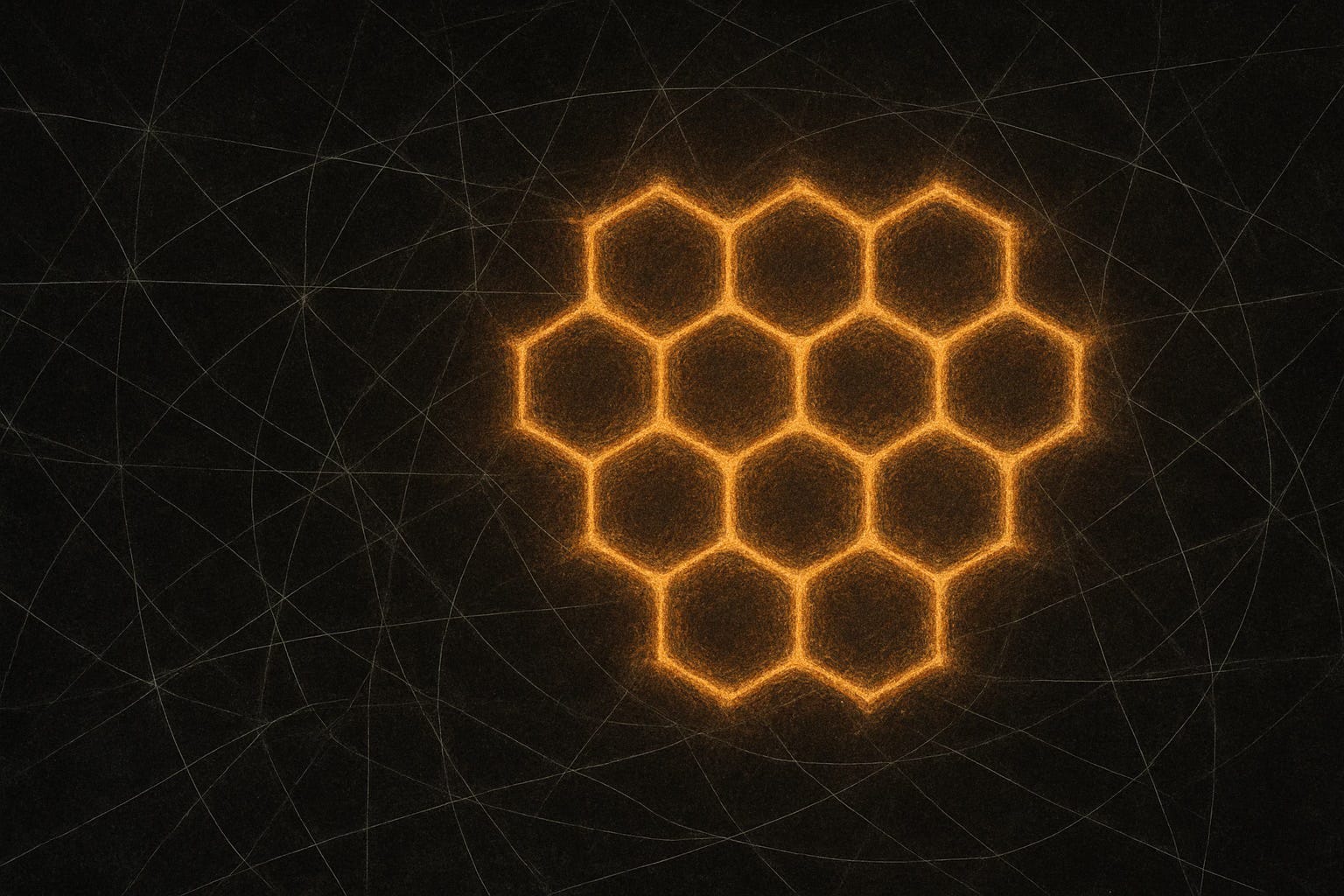
When multiple harmonics meet, they form lattices—networks of nodes where interference is stable and paths where flow remains dynamic. Matter, in this view, is energy “caught” at stable nodes in a lattice.
Incommensurable ratios like √2, √3, and phi ensure that patterns never repeat in a perfectly closed loop. They keep the universe from freezing into crystal or dissolving into noise.
This is how the Source Field supports infinite variety within a coherent architecture.
Consciousness: The Field Listening to Itself
Consciousness plays an important role in the entire system, defined primarily as self-organization in an otherwise entropic system. It is the natural force that counters the natural drive towards disorder and stabilizes the universal system enough for life to proceed within it.
Consciousness precedes matter.
It is an organizing principle that selects and stabilizes frames of reality within the Source Field.Consciousness is an energy state.
Wherever randomness is pulled into meaningful order—crystals forming, plants branching, minds thinking—consciousness is at work, to different degrees and with different levels of awareness.Consciousness is both receiver and emitter.
Each being has a unique “frequency code” in the Source Field. It picks up patterns compatible with that code and radiates its interpretation back into what Netism calls the Net—the networked total of all expressions.
In deep meditation, our brain waves slow and become more coherent. This marks a geometric shift in consciousness, moving it closer to the coherent plasmoid‑like structures described in advanced field models. In that state, we can access more layers of the Net because our internal pattern stops fighting the larger pattern.
One blunt but important claim of Netism states:
Belief gates perception.
If your internal field configuration refuses the possibility of certain experiences, your consciousness will not lock onto those signals in the Source Field. You will live in a narrower subset of what is actually available.
Plasmoids, Transmutation, and Practical Field Mastery
If this all stayed abstract, it would be an elegant philosophy and not much else. But Netism insists that the Source Field is practically accessible, especially through geometry, timing, and high‑energy events.
A few examples:
Nikola Tesla demonstrated wireless power transfer using resonant coils, elevated terminals, and the Earth‑ionosphere cavity as part of the circuit. In Netist language, he was coupling into the Source Field and letting it do the heavy lifting between transmitter and receiver.
C. P. Steinmetz framed electricity as the interplay between a magnetic field and a dielectric field (Netism’s Source Field) in the space around wires. The wire was just a guide; the energy flowed outside.
Malcolm Bendall’s plasmoid work focuses on toroidal plasma structures that appear to store, route, and reorganize energy across scales. Netism sees plasmoids as bridges where electrical, magnetic, gravitational, and even nuclear behaviors merge into one coherent field event.
In this model, chemical elements are standing wave signatures in the Source Field. Adjust the internal resonance—frequency, phase, and spin—and you can, in principle, transmute one element into another.
Plasmoids show the same geometry described above: intense, coherent, toroidal structures where the normal “lock” of elemental identity loosens, allowing rearrangement.
Whether or not you accept experimental claims, the broader Netist message is simple:
Energy is everywhere as balanced potential in the Source Field.
Engineering should treat the surrounding field as part of every circuit, not just a passive background.
Geometry, timing, and boundaries can open windows where the field’s rebalancing does useful work for us.
Aether is real, but frequently misunderstood; it is the universal Source Field—non‑material, resonant, responsive, and frame‑free—from which all matter, forces, and conscious experience emerge as patterns.
This means we are not isolated objects in a dead void; we are expressions of one continuous field, interacting through invisible geometries and resonances that are as real as the ground beneath our feet. Every choice, thought, and structure we create feeds back into that field, shaping the Net of possible realities. The stars are connected to one another as bright knots in a single medium, and so are you.
For more information on Netism, visit Netism.org
Sources and Suggested Further Reading:
The Field – Lynne McTaggart
A popular overview of research on interconnectedness and the idea that space holds structure and memory.
Tesla: Man Out of Time – Margaret Cheney
A readable biography covering Tesla’s experimentation with wireless transmission and his belief in a universal medium.
Faraday, Maxwell, and the Electromagnetic Field – Nancy Forbes & Basil Mahon
A narrative history of how the field concept shaped modern physics.
The Elegant Universe – Brian Greene
Accessible explanations of fields, spacetime structure, and unified frameworks.
The Holographic Universe – Michael Talbot
A speculative but engaging look at coherence, consciousness, and nonlocality.
The Nature of Space and Time – Stephen Hawking & Roger Penrose
A dialogue-paced exploration of what “space” actually is.
Science and the Akashic Field – Ervin Laszlo
A modern philosophical perspective linking physics with the idea of a universal informational substrate.